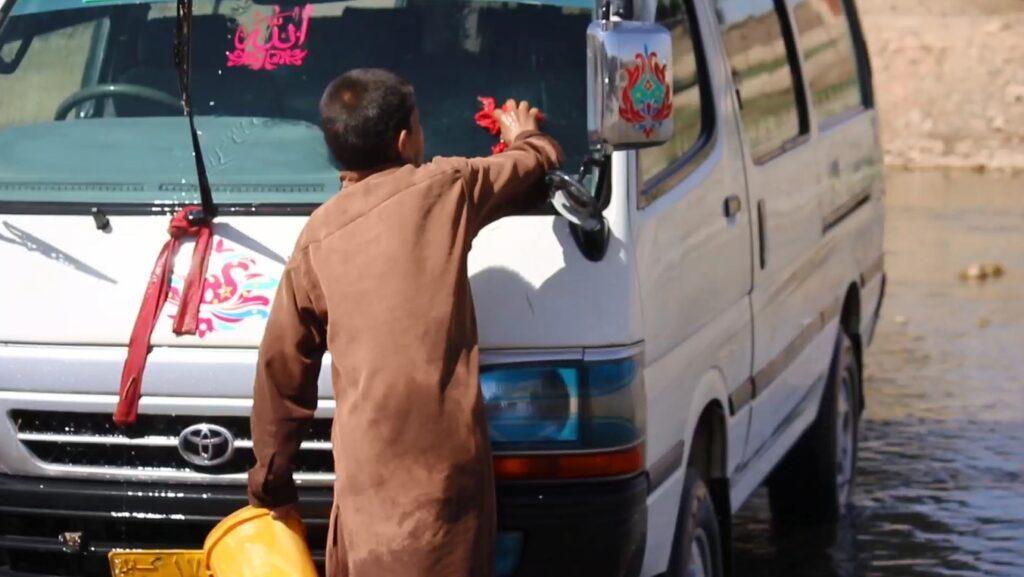
He works with his small hands but still dreams of returning to school and building a better future.
More than four decades of war across Afghanistan, including in western Ghor province, along with other challenges, have contributed to rising poverty and unemployment, leaving millions of widows and orphans behind.
A Pajhwok Afghan News reporter in Ghor has prepared a report on child labourers in Ferozkoh city, the capital of Ghor province.
The reporter’s findings show that hundreds of children from different areas come into the city every day and engage in activities such as selling vegetables and fruit, street vending, working in bakeries and workshops, working at brick kilns and other jobs.
Along the Harirud River, where dozens of cars are brought for washing every day, most of those doing the work are under 18.
At the site, children work from early morning until evening with buckets, cloths and boots, waiting for customers. By washing and cleaning cars, they help cover part of their families’ living expenses.
Ramazan, 12, is one of these children. As soon as he spots a car from a distance, he runs towards it with all his strength, trying to reach it before the others and persuade the driver to let him wash the vehicle.
Ramazan told Pajhwok: “I come here every morning to wash people’s cars and take some bread home in the evening.”
He explained that he does his work honestly to satisfy customers and encourage them to return to him when they need their cars washed again.
He added that his family’s poverty and financial hardship, as well as his elderly father’s unemployment, had forced him to shoulder the burden of supporting the family and prevented him from continuing his education.
“My father is ill and cannot work. Our financial situation is bad. I am forced to work here to meet my family’s needs. If I go to school, I cannot work, and my whole family will go hungry. There is no one to help us,” he said.
He explained that he earns around 200 to 300 afghanis a day from washing cars and spends all his income on the needs of his family of four.
He dreams that one day these difficulties will end so that he can return to school and study like other children his age.
Ramazan is not the only child working along the Harirud River to support his family. Several other children also work at the site from morning until evening, using basic equipment to wash cars.
Fourteen-year-old Nooruddin is another of these children. Poverty and the financial hardship faced by his family of five have kept him out of school and forced him to wash people’s cars every day, earning up to 200 afghanis to take some bread, tea and sugar home for his family.
Nooruddin’s father has been paralysed and bedridden for years.
He said that if his family’s financial situation improved, he would like to resume his studies so that he could become a doctor in the future and serve his people and community.
Besides Ramazan and Nooruddin, other children also help support their families through street vending and collecting plastic and scrap metal.
Thirteen-year-old Nisar Ahmad is another child who sells vegetables by the roadside every day to contribute to his family’s income.
He attends school from morning until noon. In the afternoon, he sells vegetables such as spring onions, mint, coriander, leeks and other produce from a handcart. He uses part of his earnings to help cover his family’s expenses.
He is happy with the income he earns from the work and said that he generally makes up to 300 afghanis in profit a day, although sometimes he earns more and sometimes less.
He added that although working had made it difficult for him to keep up with his studies, he was trying to continue his education while helping his family.
Meanwhile, Labour and Social Affairs Director Mullah Nasrullah Ansar told Pajhwok that the department had provided education for children at risk through its orphanage.
He said that 370 orphaned and working children were currently receiving round-the-clock education and care with financial support from the Ministry of Labour and Social Affairs.
“Ghor’s Labour and Social Affairs Department, in coordination with partner non-governmental organisations, has launched vocational and technical training programmes to support families with working children and create opportunities for them to attend schools and madrasas. We are working in this regard,” he said.
The head of the Labour and Social Affairs Department added that the programmes had provided job opportunities and technical and vocational training to 1,800 families in Ferozkoh, Taywara, Shahrak, Pasaband and Charsada districts.
According to him, the programmes aim to support vulnerable children, assist impoverished families and create conditions in which children can continue their education instead of engaging in hard labour.