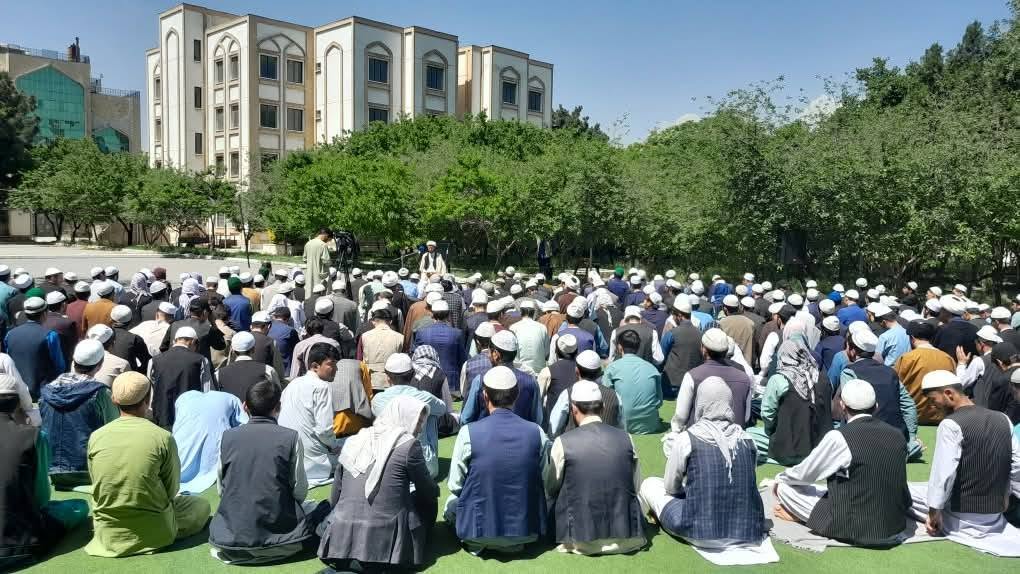
Local sources say that the Taliban, late yesterday afternoon (Saturday, September 6), entered the Khatam al-Nabiyin Seminary compound with military vehicles and a heavy presence of armed forces, demanding that the students present there vacate the premises.
This demand faced strong pushback from the students and religious scholars, because even after the seminary's buildings were sealed, the students continued their presence at the center and held their classes and prayers in the open courtyard.
The Taliban had sealed the buildings of Khatam al-Nabiyin Seminary since August. After that, the students continued their education and prayers outdoors under the sun for over two months, repeatedly asking the Taliban to allow them access to the buildings.
However, the students' peaceful requests went unanswered, and last night the Taliban attempted to expand restrictions and clear the courtyard of the seminary as well.
Reports indicate that this move was met with resistance from the students, followed by a gathering of Kabul residents around the seminary. Sources say people came out to the streets in reaction to the Taliban forces' entry and stood against this action.
According to published reports, Taliban forces resorted to force to disperse the crowd, and during the incident, a number of teachers and students were detained. Tamaddon TV reported the number of detainees as 28, four of whom were later released, while 24 others remain in Taliban custody.
Tamaddon TV also reported that when the detained teachers and students were being transferred from the seminary, Taliban Ranger vehicles encountered resistance from the public, and police forces used sticks, batons, and slaps to drive people away and disperse them.
The media outlet stated that during this crackdown, turbans of several students fell to the ground and were trampled.
Tamaddon, in its reports, described this incident as a severe and violent crackdown by the Taliban against students and civilians, saying that the Taliban resorted to force to break up the gatherings.
These developments come as tensions between the Taliban and Khatam al-Nabiyin Seminary have been ongoing for months. The Taliban claim that this seminary and its affiliated institutions belong to a party from which Ayatollah Mohammad Asef Mohseni had stepped down after the jihad period.
Seminary officials have rejected this claim, stating that they possess the necessary documents and evidence to respond to the Taliban's allegations and are ready to present them to relevant authorities and references.
However, according to Tamaddon TV, efforts to resolve the issue through dialogue and document presentation have been fruitless, and ultimately, the Taliban's Ministry of Justice, instead of continuing the reconciliation process, resorted to practical action and the use of force.
This dispute has intensified even as the Taliban's Ministry of Justice had previously sealed and locked the buildings of this complex, including various sections of the seminary. The seminary's board of directors had also stated that the disputed case was still under review in a judicial authority and that no final verdict had been issued.
But the crisis has not been limited to Khatam al-Nabiyin Seminary. Tamaddon TV, the media outlet affiliated with this institution, has also been banned from operating for months by order of the Taliban's Ministry of Justice.
The Taliban had previously halted Tamaddon TV's operations, citing its affiliation with a political party and its use of state land—claims that Mohammad Javad Mohseni, the head of Tamaddon TV, has denied.
Mr. Mohseni stated that after the suspension of its activities, Tamaddon TV had all the necessary resources to resume broadcasting and could have restarted immediately; however, upon the request and advice of a number of scholars, elders, and tribal influentials, they decided to exercise patience and restraint for a while to seek a peaceful resolution.
According to Mohseni, it was agreed that the matter would be resolved through dialogue and that their requests would be pursued through peaceful channels. But he now says the Taliban's Minister of Justice has once again chosen the path of pressure and force over adhering to commitments and the reconciliation process.
The head of Tamaddon TV, in reaction to the Taliban's raid on Khatam al-Nabiyin Seminary, stated that continued silence is no longer justifiable, and that the outlet will from now on resume its activities to reflect what it calls "existing realities."
Tamaddon has announced that it will resume its broadcasts with full force via cyberspace and satellite. In practice, the media outlet has already reactivated its presence on social media after months of silence.
Mohseni also said that the Taliban, upon entering the seminary, harassed teachers and students and detained a number of them, and that from now on, they will make all documents and records related to Khatam al-Nabiyin Seminary and Tamaddon TV available to the public.
He announced that documents regarding ownership, the dialogue process, and correspondence with the Taliban's Ministry of Justice will be published so that the public can judge the claims for themselves.
Meanwhile, Tamaddon TV also reported that electricity has been cut in and around the Khatam al-Nabiyin Seminary area—an action that, according to the outlet, was taken after the escalation of tensions and the deployment of Taliban forces at the center.
This case has now escalated beyond an administrative and legal dispute into a confrontation between Taliban forces, a major religious institution, and a segment of Kabul's population—a confrontation marked by reports of detentions of scholars and students, crackdowns on protesters, and continued pressure on affiliated institutions.
On the other hand, a number of university professors, political figures, and Kabul residents have also reacted to the Taliban's raid on Khatam al-Nabiyin Seminary, calling for an end to the violent crackdowns and a resolution of the issue through dialogue.