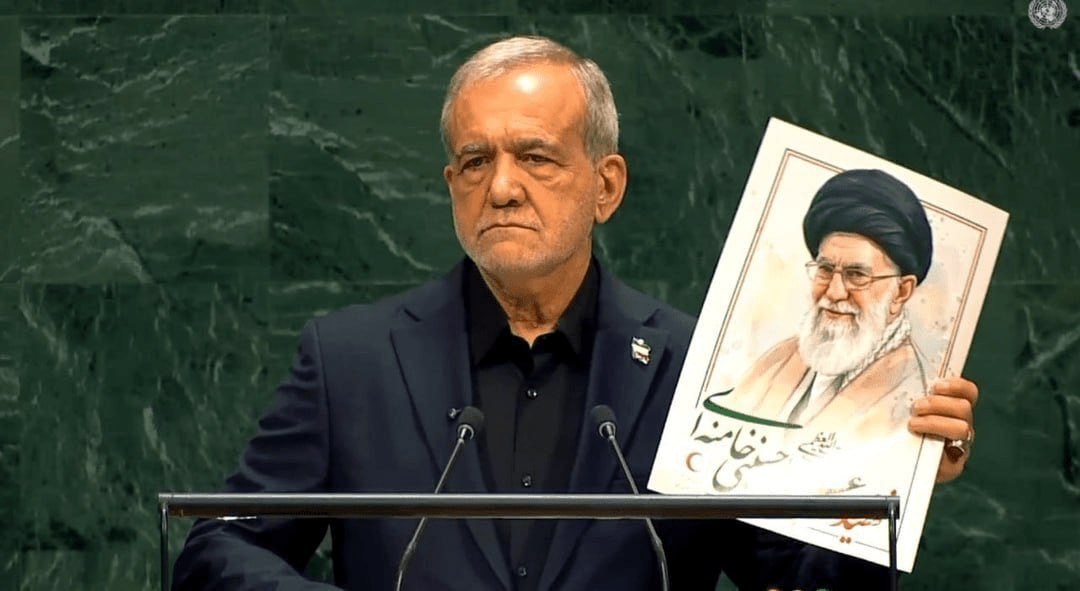
In his speech, Pezeshkian devoted a significant portion of his remarks to the consequences of the recent war, referring to the killing of a number of Iranian commanders, scientists and civilians, including women and children, and emphasizing what Iran describes as its “right to self-defense and to preserve its territorial integrity.” By displaying photographs of the victims of the war, he also sought to highlight the human dimensions of the conflict for the international public.
The Iranian president stated in his address that the people of his country would not retreat from their positions in the face of external pressure and threats, and described national independence and sovereignty as fundamental principles of the Islamic Republic’s policy. He stressed that, from Tehran’s perspective, political and military pressure cannot create conditions for imposing demands on Iran.
Another major theme of Pezeshkian’s speech was the Strait of Hormuz, a waterway that plays an important role in the global transportation of energy and has long been regarded as one of the sensitive issues in regional calculations. Referring to the importance of this maritime route, the Iranian president emphasized Iran’s role and position in ensuring its security and managing developments related to it.
Observers believe that Tehran used the United Nations platform to convey its message to the international community, following months of tensions and conflict, regarding the war, regional issues, national security and Iran’s position in developments across the Middle East. Within this framework, Pezeshkian’s speech can be viewed as an effort to present Iran’s official narrative of the recent war and emphasize the country’s policies concerning independence, security and national interests.
The Iranian president’s speech also demonstrated that, alongside addressing the humanitarian consequences of the war, Tehran is presenting national development and strength as part of its vision for the country’s future. In the view of many analysts, this message indicates that Iran seeks to portray itself as an independent country that insists on preserving its sovereignty and national interests in the face of external pressure and threats.
Overall, Masoud Pezeshkian’s address to the United Nations General Assembly can be regarded as part of Iran’s diplomatic efforts to explain its official positions regarding the war, regional developments and the future of international relations. It was an effort aimed at conveying Tehran’s message to global public opinion from the most important international diplomatic platform.