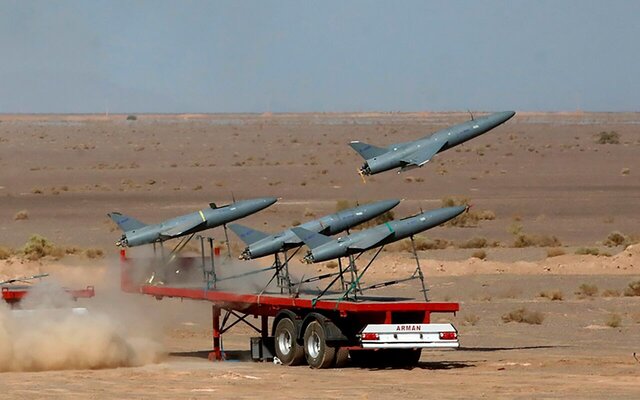
According to Pars Today, the IRGC has launched three waves of drone attacks on US military radar systems in Bahrain in less than a week. The operations have targeted an early-warning radar on November 13, an air defense radar at Al-Riffa base using six drones on November 15, and a radar at Sheikh Isa Air Base on November 17.
According to the IRGC, the successive operations were carried out in response to enemy airstrikes and the "repeated violations of Iran's airspace by US military drones," followed by the interception and destruction of MQ-1, MQ-9 and MQM-170 drones.
However, the significance of these attacks goes beyond a simple act of retaliation. What unfolded in Bahrain demonstrated Iran's ability to strike critical nodes in the US air defense network deep inside the territory of Washington's allies, while simultaneously exposing Washington's inability to deliver an effective deterrent response.
The operational dimensions of these attacks are noteworthy in several respects.
First is the selection of targets: early-warning and air defense radars, which serve as the eyes of the US defense network in the region. Their destruction or damage can undermine US Central Command's (CENTCOM) ability to intercept threats and respond swiftly.
Second is the method of execution. The use of a limited number of combat drones with high precision against targets normally protected by multiple layers of air defenses points to proficiency in penetration tactics, as well as electronic warfare capabilities to blind or deceive enemy systems.
Third is the repeatability of these operations. Carrying out three attacks in five days, despite US security warnings and the state of alert declared by Bahrain, sends the message that Iran can maintain the initiative and conduct planned strikes at short intervals.
The key point, however, lies in the US response. American officials claimed that they had shot down two Iranian drones during the November 13 attack and suffered no damage or casualties. However, regarding the subsequent attacks, Washington issued neither official confirmation nor denial. Bahrain, meanwhile, merely referred to the interception of the attacks without providing specific details about the effectiveness of its air defenses.
This silence and ambiguity point to a reality: the United States is facing a serious air defense challenge in Bahrain. Iranian drones, particularly when flying at low altitudes and with small profiles, pose a significant challenge to conventional air defense systems. When such attacks are carried out in saturation waves and from multiple directions, even the most advanced air defense networks can effectively fail to intercept all incoming targets.
Bahrain's claim that it intercepted Iranian drones, if accurate, means that some of the drones failed to reach their targets. However, what puts the United States in a weak position is that even if its air defenses achieved some success, Iran has still managed to repeat its attacks and strike new targets.
From a strategic perspective, these operations send a clear message to Washington: US military bases across the region, including in Bahrain, which hosts the US Navy's Fifth Fleet, are vulnerable to drone attacks. This vulnerability becomes more pronounced as attacks are repeated and the number of drones gradually increases.
Following Iran's second drone attack on American targets in Bahrain, the Islamic Revolution Guards Corps (IRGC) explicitly stated that "a larger number of IRGC drones were dispatched toward American targets in this phase than in the previous one."
This statement amounts to a tactical warning: Iran is testing the enemy's air defense capacity and gradually increasing the pressure without having to enter an all-out confrontation.
The attacks on American targets in Bahrain appear to be more than just a series of retaliatory operations. They have demonstrated that Iran can significantly raise the costs of the US military presence in the region while placing Washington in a position where it can neither deliver a decisive deterrent response nor acknowledge the failure of its air defenses.
In this equation, the United States has neither been able to fully protect its assets nor deliver a response capable of deterring Iran from continuing along this path. This constitutes a strategic setback whose consequences will be felt beyond Bahrain, across Washington's entire security architecture in the Persian Gulf.