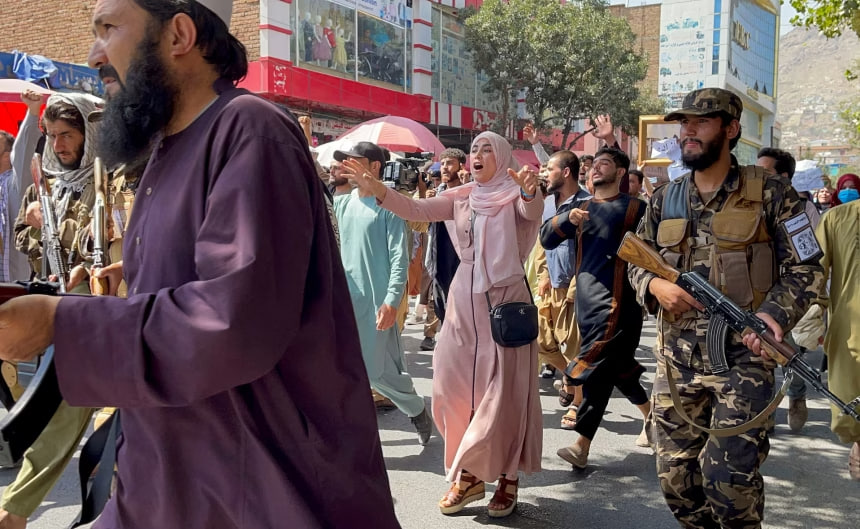
As part of its continued pressure on the people of Afghanistan, the Taliban has expanded the authority of its security forces through the new “Shurta” law. The law covers everything from banning all demonstrations to defining various powers in dealing with suspects, raising concerns about tighter restrictions on civil liberties and increased pressure on citizens.
“Shurta” is an Arabic word that the Taliban uses to refer to its police forces. The new law defines the duties and powers of these forces in 53 articles.
Protests Banned; Taliban Closes the Way for Dissenting Voices
Over the past five years, restrictions on freedom of expression, protests, and civil activities have become an important part of the Taliban’s policy of governing Afghanistan. Since the group returned to power, critics, civil society activists, journalists, and protesters have faced restrictions, arrests, and pressure, while the space for media activities and the expression of opposing views has been severely restricted. Human Rights Watch has also said that the Taliban has imposed increasing restrictions on the media and freedom of expression in recent years and has pressured critics and journalists.
In such an environment, many Afghan citizens have effectively lost the ability to freely express their opposition to the policies and decisions of the authorities. Street protests, particularly protests by women, have repeatedly faced intervention by Taliban forces. The United Nations also expressed concern in 2026 over the excessive use of force against protesters and their arrests.
Alongside restrictions on street protests, pressure on the media and on those who criticize Taliban policies has also continued. Human rights reports indicate that journalists and critics have been arrested and subjected to various forms of pressure, while broad restrictions have been imposed on media activities.
Now, in the fifth year of Taliban rule, the new “Shurta” law can be seen as another step in the same direction. Article 50 of the law explicitly states: “Any demonstration within the territory of Afghanistan is prohibited.” Thus, what had previously been enforced in many cases through preventing demonstrations and confronting protesters has now also been incorporated into a legal provision.
This prohibition is not merely about preventing people from gathering in the streets. It could further restrict one of the few means available to citizens to convey their grievances to the authorities. When protest gatherings are prohibited, what means does a citizen who is dissatisfied with a decision, the economic situation, a social restriction, or government conduct have to make their objection heard by officials?
The importance of this issue becomes even greater when the ban is considered alongside other restrictions. In recent years, restrictions imposed on women and girls, the media, civil activities, freedom of movement, and freedom of expression have narrowed Afghanistan’s public space. Human Rights Watch says that the Taliban further intensified restrictions on the rights of women and girls and on the media in 2025. The United Nations has also described Afghanistan’s human rights situation in 2026 as continuing to deteriorate.
From this perspective, Article 50 of the “Shurta” law is not merely a provision concerning demonstrations. It could be regarded as a sign of the formalization of restrictions on the right to protest and citizens’ participation in public life. People who have faced numerous restrictions on expressing their demands in recent years are now confronted with a law that prohibits the very act of holding demonstrations throughout the country.
And this is where the central question arises: If protests are prohibited and dissenting voices are not tolerated, how can citizens express their demands and grievances?
“Shurta” with Broad Powers; People Facing Security Power
The Taliban’s new “Shurta” law grants broad powers to its forces in dealing with citizens at a time when the group has repeatedly confronted protests and dissenting voices over the past five years—from the arrest and torture of protesters and critics to pressure on journalists and civil society activists. Now, in a new law, the Taliban has both banned all demonstrations and granted its forces powers to deal with suspects, further increasing concerns about growing pressure on citizens.
This approach is being pursued at a time when any independent voice can challenge the policies of the authorities. Instead of creating legal and peaceful channels for people to express their protests and grievances, the Taliban has prohibited the very act of protesting in the new law. This approach raises the question of why the authorities are so determined to prevent the emergence of dissenting voices in society.
Article 50 of the law is explicit: “Any demonstration within the territory of Afghanistan is prohibited.” This provision effectively deprives citizens of one of the most recognized means of expressing their opposition. In a society where the media and civil activities are also subject to extensive restrictions, banning demonstrations could close off the last remaining avenue through which people can collectively express their grievances.
On the other hand, Article 41 allows the “Shurta” forces to use coercive methods to “reform” a suspect and, in the case of suspects accused of major crimes, to threaten them with death. Although the law prohibits torture and beating without a court order in some sections, granting such powers to security forces in a country where independent mechanisms for monitoring the conduct of security forces are limited could increase concerns about the abuse of power.
Thus, the new “Shurta” law is not merely a set of regulations for the Taliban’s police forces. It is part of a broader process of controlling Afghanistan’s public space—a space in which a dissatisfied citizen is not only restricted in expressing opposition but is now also confronted with a law that explicitly prohibits street protests.
The “Shurta” Law: When Security Moves Closer to People’s Private Lives
Concerns about the new “Shurta” law are not limited to streets and political protests. Some sections of the law concern the way security forces deal with citizens and implement punishments, and this could further expand the presence and intervention of security forces in people’s everyday lives.
Over the past five years, the people of Afghanistan have faced increasing restrictions in their social lives. Many decisions that were previously considered ordinary personal choices are now affected by Taliban regulations and orders—from dress and movement to media, cultural, and social activities. Under such circumstances, the adoption of a law that defines and, in some cases, expands the powers of the “Shurta” forces could further increase concerns about surveillance and control over people’s lives.
One notable provision in the law is the prohibition on taking photographs or recording videos of the implementation of punishments. This restriction comes at a time when the publication of images and videos has previously been one of the means of informing the public about how punishments are carried out and how Taliban forces behave. The ban on recording could now further restrict public and media access to information about the implementation of punishments.
On the other hand, the new law allows “Shurta” forces to use firearms under specific circumstances. According to Article 39, the use of weapons is permitted in cases such as “rebellion,” armed crimes against security, and armed warfare. Although the law specifies the circumstances in which weapons may be used, the fundamental questions of how these situations will be determined and how the conduct of the forces will be monitored remain.
The importance of this issue becomes greater when we consider that numerous reports have emerged in recent years concerning violent treatment of citizens, the arrest of critics and protesters, and mistreatment of prisoners. Human rights organizations have repeatedly called on the Taliban to hold its forces accountable for violations of people’s rights.
In fact, the main concern is not merely what is written in the law. The issue is how these powers will be used in practice. If a citizen wants to complain about the conduct of an officer, if a suspect claims that they have been mistreated, or if a family has questions about how a punishment was carried out against one of its members, what independent institution can investigate the conduct of the “Shurta” forces?
The new law has been published at a time when Afghanistan’s public sphere has been stripped of many independent mechanisms for overseeing those in power. The media faces restrictions, protests are prohibited, and civil activities also encounter serious obstacles. In such an environment, expanding the powers of security forces without establishing clear and independent accountability mechanisms could further widen the gap between the people and those in power.
Ultimately, the 53-article “Shurta” law can be viewed as part of a broader trend that, over the past five years, has transformed Afghanistan’s public sphere from a space for citizens’ participation and protest into an environment characterized by greater security control. The important question now is to what extent this law could provide the Taliban’s forces with additional tools to control and suppress the people.
دیدگاه شما درباره این خبر چیست؟
دیدگاه خود را محترمانه و روشن با دیگران به اشتراک بگذارید.
نظرات مخاطبان
0 دیدگاههنوز دیدگاهی ثبت نشده؛ شما آغازکننده گفتوگو باشید.