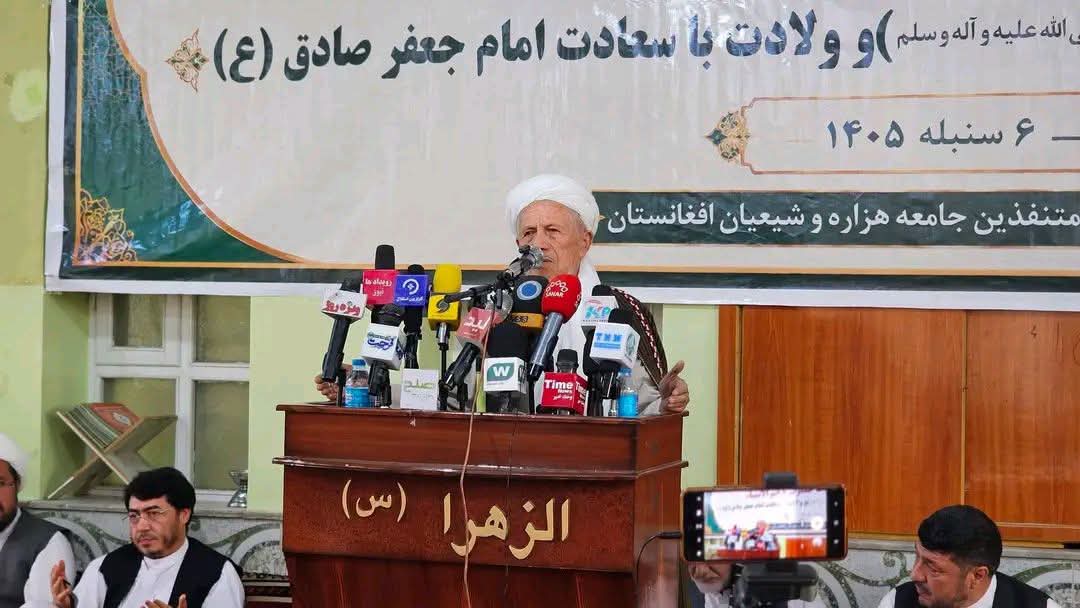
A number of religious scholars, influential figures, and prominent members of Afghanistan’s Shia community gathered today, Friday, 6 Sonbola, at the Al-Zahra Mosque in Kabul to mark the birthday of the Prophet Muhammad (PBUH) and called on the Taliban to pay attention to the demands and concerns of the Shia community.
Sources say several Taliban officials, including Taliban Prime Minister Mullah Hassan Akhund, Abdul Salam Hanafi, and the Minister for Borders and Tribal Affairs, had been invited to the gathering. However, Noor-ul-Haq Anwar, head of the Taliban’s Administrative Office, attended the ceremony.
Shia Demands: From Personal Status Law to Participation in Government
Sayed Hussein Alami Balkhi, a member of the Council of Shia Scholars of Afghanistan, once again called on the Taliban to address the demands and concerns of the Shia community and criticized what he described as the Taliban’s disregard for these demands.
Referring to a statement previously sent by the Council of Shia Scholars of Afghanistan to the Taliban leader in Kandahar, Alami Balkhi said that no response had been received to these demands so far.
He stressed that the Shia community would continue pursuing its demands and called for the recognition and observance of Shia personal status law, as well as serious attention by the Taliban to the community’s concerns.
Balkhi also called for Shia participation in the Taliban government structure, saying that a dedicated committee should be established to address the problems and demands of the Shia community. Such a committee, he said, would communicate the community’s demands directly to the government and follow up on the process of addressing them.
He emphasized that the demands of the Shia community should not remain limited to promises and statements, and that the Taliban must take practical steps to respond to them.
Meanwhile, Noor-ul-Haq Anwar, head of the Taliban’s Administrative Office, addressed the gathering. Responding to the demands raised by Shia scholars, he said their statements and positions carried “the smell of the republic.”
He also claimed that no inclusive government had existed in Afghanistan during the past 300 years and that even neighboring countries had failed to establish such a government. Anwar described the current Taliban administration as “inclusive and Islamic” and said it emerged following the defeat of the United States and NATO in Afghanistan.
In another part of his speech, Anwar discussed lands and residential townships declared by the Taliban to have been illegally seized. He said he had met with Taliban Justice Minister Abdul Hakim Sharaee several days earlier to discuss the issue. According to Anwar, the justice minister said at the meeting that “the law is for everyone and makes no distinction between Shia and Sunni,” and that if Haji Nabi Township or any other township in Afghanistan is declared state-owned, the government will take control of it.
Anwar also spoke about what he described as “relative security” in Afghanistan, adding that some people were attempting to disrupt the country’s security by establishing armed fronts.
The Taliban’s “Inclusive Government”: What Has Been the Shia Community’s Share Over the Past Five Years?
While the head of the Taliban’s Administrative Office has once again described the group’s government as “inclusive,” criticisms raised by a number of Shia scholars in recent years present a different picture of the situation facing the community.
Ayatollah Waezzada Behsoodi, a prominent Shia scholar in Afghanistan, has in recent months criticized increasing pressure on followers of the Jaafari school of Islam, saying restrictions on Shia Muslims—particularly students and religious scholars—have increased. He has also criticized the failure of Taliban authorities to respond to requests by Shia scholars for a meeting with the Taliban leader, saying: “The Islamic Emirate’s ears are deaf.”
Previously, Sayed Mohsen Hojjat also criticized restrictions imposed by the Taliban on Muharram ceremonies, objecting to limitations on Shia religious rituals and the treatment of mourners, and called for respect for the community’s religious practices.
Despite these criticisms, the Taliban have not only failed to address the demands of the Shia community but have also increased pressure and restrictions on Shia religious ceremonies.
Shia and Hazara representation within the Taliban government’s decision-making structures also remains limited. At present, Abdul Latif Nazari, Deputy Minister for Technical Affairs at the Ministry of Economy, and Madar Ali Karimi Bamiyani are among the few Hazara figures holding positions at the deputy-minister level.
However, these figures do not necessarily represent the Shia and Hazara communities. Their presence in the Taliban government does not constitute formal representation of these communities, and in many cases their positions on demands raised by Shia groups have not been regarded as representing the community.
Nevertheless, five years on, the Shia community’s share in the Taliban government remains very limited, and the group has not agreed to include genuine representatives of the Shia community in the government’s key decision-making structures.
The gathering took place amid reports of increased pressure on the Hazara and Shia communities in recent weeks. A number of Hazara and Shia scholars and influential figures issued a statement accusing Taliban Justice Minister Abdul Hakim Sharaee of “systematic discrimination” and attempts to carry out the “forced displacement” of Hazaras and Shias.
In the statement, they protested the closure of the Afshar-Darulaman cemetery, the detention of several residents of the Sanatorium area, the demolition of the area’s mosque, orders to evacuate Omid Sabz Township, the suspension of broadcasts by Tamadon TV, the closure of the Khatam al-Nabieen Mosque and madrasa, and restrictions on the activities of several Shia religious and cultural centers.
Following the statement, the Taliban justice minister summoned Hazara and Shia leaders to his office. However, they declined to attend the meeting, saying they would only agree to talks if senior Taliban officials requested a meeting with them.
Today’s gathering in Kabul took place as Shia scholars once again raised the community’s demands in the presence of a Taliban official—demands which, according to them, remain unanswered five years after the Taliban’s return to power.
دیدگاه شما درباره این خبر چیست؟
دیدگاه خود را محترمانه و روشن با دیگران به اشتراک بگذارید.
نظرات مخاطبان
0 دیدگاههنوز دیدگاهی ثبت نشده؛ شما آغازکننده گفتوگو باشید.