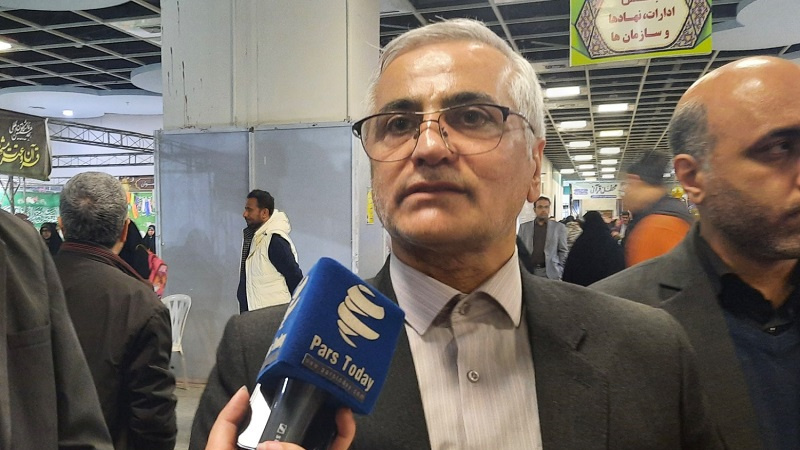
Amirullah Shomghadari, the Security Deputy Governor of Khorasan Razavi, on the sidelines of the "Servants of Empathy 2" ceremony—held in holy Mashhad to honor executive bodies and service caravans that provided services to pilgrims and migrants during the final decade of the lunar month of Safar—answered journalists' questions regarding the registration of foreign students and migrant health insurance.
Emphasizing the importance of education for foreign students for the authorities of Khorasan Razavi, he stated: "It is important for us to provide educational opportunities for the dear foreign students residing in our province, and we are trying to facilitate education for those whose residency documents have issues—even through temporary permits."
Shomghadari referred to the positive approach and favorable view of Khorasan Razavi's officials toward the education of foreign students and said: "Everyone must help this process together. Unofficial schools must not exist, and migrant schools must be approved by the Office of Foreign Nationals and Migrants' Affairs."
The Security Deputy Governor of Khorasan Razavi also addressed the costs of the health insurance plan for foreign nationals, which is beyond the means of some migrant families, and stated: "Insurance is a national policy, and many of the costs are covered from the share of Iranian families for Afghan nationals. Even if the premium is high, the subsidy paid is also very high, and we hope to make a balanced decision in this regard."
Shomghadari also referred to the organization of joint cultural and religious programs between Iran and Afghanistan, stating that the lawful presence of Afghan nationals and utilizing their capacities in economic, social, scientific, cultural, and educational sectors are serious priorities for the authorities of this province.
He described the programs held for the Arba'een of Imam Hussein (peace be upon him) and the final decade of Safar as symbols of empathy, solidarity, and sincerity between the people of Iran and Afghanistan, and said that holding these events resulted from cooperation and synergy among grassroots organizations, NGOs, cultural and social activists, and executive institutions in Iran and Khorasan Razavi.
Referring to last year’s situation, he said: "Last year, due to the non-issuance of Iraqi visas, Afghan pilgrims could not participate in the Arba'een ceremonies; however, the opportunity to visit the shrine of Imam Reza (peace be upon him) was provided for them."
The Security Deputy Governor of Khorasan Razavi added that this year both opportunities have been made available, and nearly 12,000 Afghan pilgrims have traveled to the holy shrines (Atabat) in Iraq, while at the same time, the possibility of visiting Imam Reza's shrine has also been provided for them.
Shomghadari emphasized the role of cultural and social programs in improving issues related to Afghan migrants and stated that these events can help strengthen relations and empathy between the two communities.
He described Afghans as possessing significant capacities in economic, social, scientific, cultural, and educational fields and stressed the necessity of utilizing these capacities.
Shomghadari said: "The lawful presence of foreign nationals is important both for us and for the elites, officials, and social and cultural activists from Afghanistan."
In conclusion, the Security Deputy Governor of Khorasan Razavi emphasized that the issue of Afghan nationals is a serious priority for the provincial authorities, and efforts are being made to facilitate their lawful presence and better utilization of their capacities in Khorasan Razavi.